




The grinding balls bulk weight in mill without unloading grinding media

The material science and steels heat treatment. Metal treatment type “the rolling”
The metals treatment by pressure based on their ability to plastically deform under certain conditions, as a result of external forces influencing on deformed body (billet).
The metals treatment processes divided into two types by appointment:
- Type for billet production of constant cross-section by length (bars, wires, tapes, sheets) used in building structures or for the subsequent details manufacture. Treatment performs by cutting or by preliminary plastic shaping. The main types of such processes are rolling, pressing and dragging.
- Type for obtain parts or billets (semi-finished products) having approximately shapes and dimensions the finished details. They require treatment by cutting only to give them final dimensions and the set quality surface. Forging and stamping are the main varieties of such processes.
The rolling
The rolling consists in billet compressing between the rotating rolls. The billet retracts between the rollers by friction forces, and the pressure forces reduce the transverse billet dimensions. The pressure forces are normal to the rolls surface.
The pressing
The pressing consists in billet pressing at closed form through the matrix hole. A cross section shapes and dimensions of the billet pressed segment, correspond to the matrix hole shapes and dimensions.
The dragging (drawing)
The dragging consists in pulling the billet through the matrix narrowing cavity. The billet cross-sectional area reduced and takes the matrix hole cross-section form.
The forging
The forging change a billet shape and dimensions by successively applying a universal tool (strikers) to the heated billet individual sections.
The stamping
The stamping changes the billet shapes and dimensions by a specialized tool – a stamp (each stamp produced for each detail). The stamp consists of a matrix, a punch and additional details. Distinguish volumetric stamping and sheet stamping.
Profiled metal cut into billets used as a billet in volumetric stamping. The billet affected by a specialized tool – punch, whereby the metal fills the matrix cavity acquiring it shapes and dimensions.
Sheet stamping produces flat and spatial hollow details from billet with a thickness much less than the dimensions in the plan (sheet, tape, strip). Usually the billet deformed by a punch and a matrix.
The combinations
These processes use combinations from several methods (for example, the rolling-drawing method).
- The metals treatment call “a cold treatment the metals”, when it carry out at a temperature below the recrystallization temperature.
- The metals treatment call “a hot treatment the metals”, when the metal heated above the recrystallization temperature.
The main laws of metals treatment are:
The volumes constancy law – the metal volume before deformation is practically equal to the metal volume after deformation.
Law of least resistance – the deformable metal particles always move in the least resistance direction.
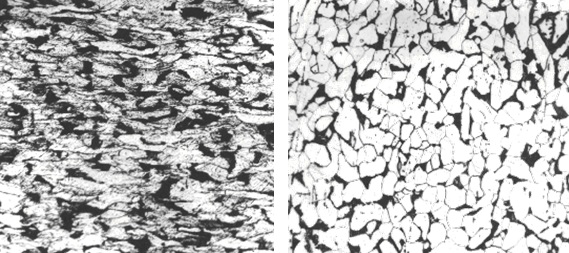
Crystallites (grains) change the shape and orientation and forming a fibrous structure with a predominant crystals orientation, during plastic deformation of polycrystalline solids. The grains are deformed and flattened, stretching in the deformation direction (Picture 1).
a b
Picture 1. The metal microstructure: a – metal after cold deformation;b – metal in the initial state.
The predominant crystallographic grains orientation along the deformation direction called a texture. The texture formation promotes appearance the properties anisotropy along and across the fibers direction.