



5 сommon mistakes when selecting grinding balls
23.07.2026
Energosteel team visits a long-standing partner – an aerated concrete manufacturer
13.08.2026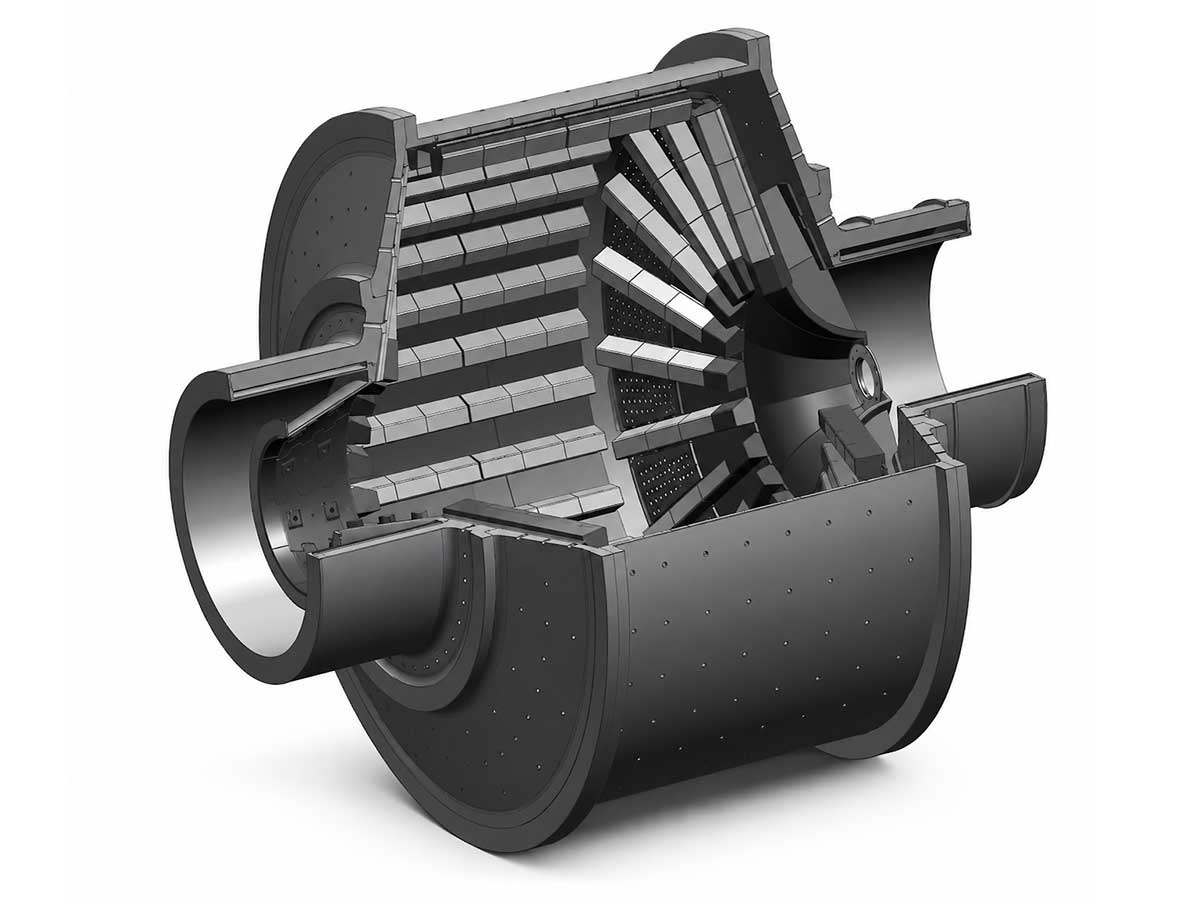
When analyzing the causes of grinding ball wear, the main focus is usually placed on ore properties, the characteristics of the grinding balls themselves, or the mill operating conditions. However, an additional important factor is the mill liner, which influences the trajectory of the ball charge and its operating conditions.
The primary factor determining the motion of grinding balls is the mill rotational speed relative to the critical speed. However, the liner also plays an important role in shaping the trajectories of the grinding balls.
The lifter height, profile, spacing, and degree of wear largely determine how high the ball charge is lifted before it detaches from the liner. Therefore, even at the same mill speed, different liner designs can produce different proportions of impact and abrasive grinding mechanisms.
At the beginning of its service life, the lifters have their maximum height and effectively lift the ball charge. During this period:
- the balls are lifted to a greater height;
- the impact energy increases;
- impact grinding becomes more intensive;
- impact loads on both the grinding balls and the liners increase.
When coarse feed is processed under appropriate mill operating conditions, this contributes to more efficient breakage of the material. At the same time, the share of impact loading acting on the grinding balls may also increase.
As operation continues, the lifter height gradually decreases. In addition to reducing the ball lifting height, liner wear may also change the point at which the ball charge detaches from the liner, further affecting the motion of the grinding balls inside the mill. As a result:
- the impact energy decreases;
- the role of impact breakage is reduced;
- in many cases, the relative contribution of abrasive wear increases;
- the grinding efficiency of coarse particles may decrease.
The extent of these changes depends on the liner design, the mill operating conditions, and the characteristics of the material being ground.
In conclusion, the mill liner performs more than just a protective function. Its design and current condition can influence the trajectories of the ball charge, the intensity of impacts, and the wear mechanisms affecting grinding balls. Although its influence is generally less significant than that of ore characteristics and mill operating conditions, the condition of the liner should also be considered when analyzing changes in grinding media consumption or grinding efficiency.